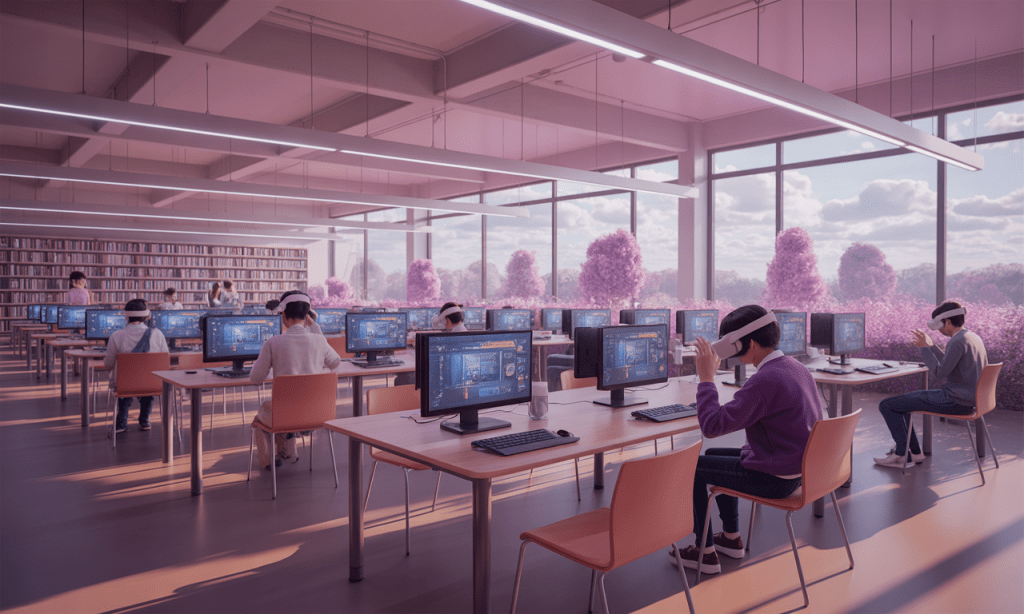
Learning Beyond Limits: How AR and VR Are Transforming Our Library Commons Lab
Our original Library Commons Computer Lab Proposal envisioned a $59,923 transformation of the existing computer space into a flexible, future-ready learning hub designed for adult learners, higher-education students, and community members. The redesign focused on upgraded desktop stations, collaborative worktables, improved accessibility features, high-speed connectivity, and modular seating to support workshops, tutoring, hybrid learning, digital literacy, and workforce development. In short, the goal was to build an inclusive, modern environment where learners of all backgrounds could access the technology and support needed for academic and career success.
Now, we are taking that vision a step further.
Something remarkable is happening in our Library Commons Computer Lab. We’re not just adding new technology, we’re fundamentally reimagining what learning can look like when we move beyond traditional screens and textbooks. With the integration of Virtual and Augmented Reality (VR/AR) tools, including Meta Quest 3 headsets, Merge Cubes, and CoSpaces Edu, our learners are stepping into experiences that were once impossible to access within our walls.

Imagine a nursing student practicing patient care in a realistic hospital simulation or a budding engineer manipulating a machine component as if holding it in their hands. These aren’t futuristic fantasies; they’re becoming everyday realities in our space.

Now imagine an adult learner in a literacy program using augmented reality to explore vocabulary by scanning objects in their environment, instantly seeing words, pronunciations, and sentence examples projected before them. Or picture an adult English language learner entering a virtual grocery store, practicing reading product labels, asking for help, and following written directions in real-time.

Recent research validates what we’re witnessing firsthand: immersive learning environments significantly enhance academic achievement and learner engagement (Akgün & Atıcı, 2022). When students and adult learners can visualize abstract concepts through spatial understanding, walking around a DNA helix, exploring the interior of a human heart, or reading a story that comes alive through interactive 3D imagery, comprehension deepens in ways traditional methods cannot replicate (Stelter & Kim, 2023; Chen et al., 2022).
What excites us most is how these technologies spark creativity and curiosity. In artistic, design, and literacy-rich environments, AR platforms are proving particularly transformative, encouraging learners to experiment, imagine, and interact with content in meaningful ways (Chen et al., 2022). We’re watching learners who once struggled with engagement become active participants in their own learning journeys.

This isn’t just about keeping up with technology trends. By integrating AR and VR into our Library Commons, we are creating a truly inclusive innovation hub, a space where learning becomes tangible, accessible, and profoundly meaningful. Every learner, regardless of background or learning style, can now engage with complex ideas in ways that resonate personally.
References:
Akgun, O. E., & Atici, B. (2022). The effects of augmented reality and virtual reality on academic achievement and engagement. Educational Technology Research and Development.
Chen, Y., et al. (2022). Augmented reality in creative learning: Fostering innovation and curiosity. Journal of Educational Innovation.
Stelter, A., & Kim, J. (2023). Spatial learning and visualization through immersive technologies. Learning and Instruction.
 Words, Wealth & Wisdom